Sunday, February 15, 2009

Homeschooling ABCs from Knowledge Quest

Homeschooling can be a lot of things...exciting, adventurous, and a whole lot of fun. It can also be frustrating, confusing, and downright intimidating. Without a plan, some wise advice, and a little bit of hand holding starting out in homeschooling can seem overwhelming. I am blessed to live in a location that has an extensive community of homeschooling families. I am able to ask questions and receive answers and help whenever I am in need. But even so, this very first year of homeschooling has had its moments of doubts and tears. Where can I get help at answering questions about getting started in homeschooling when sometimes I don't know enough to know what questions to ask? Terri Johnson at Knowledge Quest has put together a 26-week resource called Homeschooling ABCs to fill this very need.

Homeschooling ABCs is a weekly PDF lesson sent by email on various topics useful to both the just-getting-started and the already-done-this-for-a-few-years homeschooling families. Each of the 26 lessons, labeled A through Z, are about 10-12 pages in length. The first six lessons give a good explanation of how to get your homeschool started: basic supplies, setting up a space in your home for learning, understanding your children's learning styles, determining your education philosophy, and finding curriculum. From there Terri takes you through steps to make homeschooling a successful experience: getting in touch with other homeschoolers for support (either local or online), incorporating hands-on learning in each subject, developing research skills online and at the library, how to establish and guard homeschooling time, teaching Kindergartners and Preschoolers, and juggling house maintenance, daily living, and learning all in the same space. Terri goes on to get more specific in certain subjects: making math fun, how to plan science over the 12 years of schooling, teaching reading and spelling and phonics, planning field trips, why music is important for children to study, and helpful information on teaching special needs children.

My final verdict: I have only received lessons A-R, but they have all been wonderfully helpful and packed full of great extras. I am confident that lessons S-Z will prove just as useful. I like how the lessons begin at the beginning helping answer the very basic questions like: How do I start homeschooling? I had never seen a homeschool day in someone else's home, so starting was almost the hardest part. It's great to have some handholding right in the beginning! It was also very, very helpful to read about the different teaching and learning styles. Before starting in homeschooling, I would read brief mentions about Charlotte Mason, unschooling, classical education, kinesthetic learners, auditory learners, visual learners...what did it all mean? Terri lays out the basics to quickly end the confusion. The other lessons that I've appreciated the most: choosing curriculum and living and learning at home. I am excited to see what the final 8 Homeschooling ABCs lessons will hold!
Terri Johnson has done a fantastic job making brand new homeschoolers feel more at ease about the decision to homeschool and making it happen successfully. Homeschooling families with a few years under their belts will appreciate the ideas that may help to refine certain parts of their homeschool. And everyone will love all the freebies that are included in each lesson when you sign up for Homeschooling ABCs. The cost is $10 a month for 6 months...that figures out to only $2.30 per lesson! I would highly recommend you check out Homeschooling ABCs from Knowledge Quest!

Wednesday, February 4, 2009

StoryBuilders from WriteShop

When it comes to using imagination to think up a creative story, my daughter usually needs no assistance, BUT it can get even more fun (and funny!) using StoryBuilders from WriteShop.

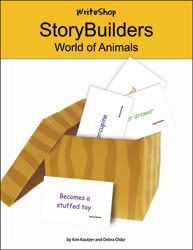
My daughter and I used World of Animals StoryBuilders. It's a 63-page E-book that comes with instructions for using the card decks and provides enough inspiration to keep minds creating stories for a long time to come. You have the option of printing out black type onto colored cardstock or the color-coded type printed onto white cardstock for the four categories: character cards, character trait cards, setting cards, and plot cards. There are even blank cards provided to add your own ideas to the mix.

My final verdict: These cards are pretty versatile! Not only can they spark some fun story ideas for writing assignments, they can be used as a travel game just as easily. My Kindergartner came up with a cute story about a bashful shark (named Bernice) who always wanted to invent something. As the story developed-in my daughter's imagination-Bernice ended up inventing a dryer...because, well, everything is so very wet in the ocean! This is a great and affordable resource to help fight writer's block. StoryBuilders are available in four different E-books: World of Animals, World of People, and World of Sports- each only $7.95, and a Christmas Mini-Builder- $3.95. Take a close look at StoryBuilders and all the other writing resources available at WriteShop.

Wednesday, January 28, 2009

All About Homophones

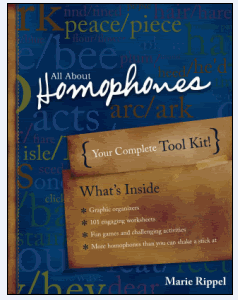
Brought to you by the creator of All About Spelling (see review of AAS here), Marie Rippel has now published All About Homophones. This 240-page workbook takes children (suggested grades 1st-8th) through fun activities while they learn and test their knowledge of common homophones--words that sound alike but are spelled differently and have different meanings. For the teacher the book provides worksheets of different kinds of graphic organizers, a list of suggested children's books that are helpful in learning homophones (great idea!), answer keys, and a master list of homophones used in the book as well as a long list of others. For the student there are fun fill-in-the-blank worksheets, ready-to-print-on-cardstock card games, crossword puzzles, riddles, puns, and tongue twisters. Also provided is a simple worksheet where the student can record the homophones they have learned in one list.

My final verdict: It is a fun workbook that can get kids excited about a pretty neat phenomenon in the English language! My daughter (grade K) enjoyed going through the activities for the homophones for grade 1 and some of grade 2. She even explained to her dad what homophones are and then quizzed him to see if he knows the difference between "be" and "bee" and "see" and "sea." What a blast to see her learn it, review it, and then teach it to someone else! The book is available in hardcopy as a softback workbook for $29.95 or as an E-book for $27.95. ALERT: Special offer that is good only until February 2, 2009: get $10 off any order of All About Homophones with coupon code FUN. See some sample pages from the workbook.

Saturday, January 24, 2009

Nana Star and the Moonman from ee Publishing and Productions

"It was a wonderful day for Nana Star to begin her journey to return the lost baby star to his home in the heavens." So begins the 26-page story of, Nana Star and the Moonman, by sisters Elizabeth Sills and Elena Patrice.

My final verdict: What I like: As children read the book they are asked to keep an eye out for a misspelled word. The explanation from the author in the introduction is that, "...we all make mistakes...only God can make all things perfect." I like how that immediately gives the child a reason to pay close attention to what they're reading, and I agree with the explanation.
What I did not like: This is the second book in a, so far, two book series. It is not a satisfying story on its own and reads more like a chapter rather than a book in its own right. A bigger issue than the quality of the story, for me, is its message. Once God is mentioned in the introduction, He is nowhere to be found in the actual story. Animal's are referred to as, "Nature's creatures, " and the moon is given the lofty responsibility of being Nana Star's guardian. "Do not be afraid, little Nana Star. Remember, I am the Moonman and I will be with you always. Even when you can't see me, I am with you, watching over you." This is walking a fine line between someone's idea of symbolism for God and elementary notions of New Ageism. The authors could have easily made sure that God was given the due credit as Creator of all creatures or as the One who can comfort Nana Star in times when she feels afraid. These are the truths that I am teaching my children in our home.

Though Nana Star, the Moonman, and ee Publishing and Productions have won quite a few awards, I am not a fan. I know that some may say that I'm reading things that aren't there. When it comes to my young children, I will not hesitate to err on the side of caution. The story sends a confusing mix of messages to young readers. When there are lots of God honoring choices in early children's literature available, I do not feel like I have to compromise by choosing a story like Nana Star and the Moonman.

Thursday, January 22, 2009

The Critical Thinking Co.

Are you a Critical Thinker? See if you can figure out the following:
  1. You have only an 8-liter jug and a 3-liter jug. Both containers are unmarked. You need exactly 4 liters of water. How can you get it, if a water faucet is handy?
  2. While relaxing on the deck outside her cabin one summer evening, Vivian fell into a deep trance-like sleep. When she awoke, she felt as if she had slept only an hour or two, but it was now the middle of winter. How could this be?

The Critical Thinking Co. offers products that will help children develop and strengthen critical thinking skills. I had the opportunity to use one of their titles: Building Thinking Skills- Primary.

The Primary book is for Grades K-1. This large volume, 265 pages broken down into eleven chapters, begins with describing shapes and ends with making analogies. The first four chapters on shapes does require the use of attribute blocks and interlocking cubes available for separate purchase on the website. Children learn to describe a shape by color, size, location (middle, first, last, left, right, top, bottom, above, and below), and to be able to write the descriptions as well. They match, compare, and sequence shapes. Finally, children learn to group, sort, and classify shapes. Starting in Chapter 5 and going all the way to the end of the book, using the skills already learned about describing, sequencing, and classifying, children begin to organize information about family members, food, animals, occupations, vehicles, and buildings.

My final verdict: This book is a fantastic resource to get my daughter thinking critically! I like how it gets her to look at attributes to organize and classify. It is a fun way to begin to learn to look at information and make sense of it. Some downers: This workbook is expensive ($29.99) and the necessary blocks and cubes make it an even larger investment ($20.99 and $11.99). The workbook is non-reproducible, so one per child is necessary. The pages are not perforated. It soon becomes difficult to write, trace, and color when the child's hand is resting on the large lump of book spine due to the workbook's many pages. My solution? This is a workbook that I will probably end up chopping off the binding, three-hole-punching, and putting in a ringed binder so that my daughter can work on the pages individually without burden. Is this book worth the cost? I believe so. Yes it's pricey, but I believe it's money well spent to get a child off to a good start learning basic skills for thinking critically...and the workbook makes it FUN! The Critical Thinking Co. has LOTS of books and software to exercise the brain. Check them out, and find out the answers to the two questions above and more to see if you ARE a Critical Thinker!

Monday, January 19, 2009

Bible Story Songs

Raise your hand if you've ever been subjected to a single children's music CD for so long that you have memorized each song in its playlist order, the lead and accompanying parts and can even imitate the instruments at times tempting you to seriously consider pitching said CD from the open window of your vehicle while driving at highway speeds. Anyone?! Ok, I think I'm not alone in this.
So I get this new CD in the mail from Bible Story Songs to listen to and to review...Moses, Volume 1- The First 80 Years. My oldest daughter is THRILLED! First question out of her mouth, "Can we listen to it in the car??" Put on your seat belts...here we go.

My final verdict: Ok, ok...I admit it, I love this CD. I mean it! It is really, REALLY good! The songs take you through the first 80 years of Moses' life, from his birth to his leading the Israelites out of captivity in Egypt. The music and lyrics are great and are, for the most part, sung and narrated by (older) children. I like that these songs are new--I've never heard them before, AND they follow the Biblical story of Moses--with some scripture memory! Yes, we've listened to this CD more than I'd like to admit, and I have had to swap it out with other music from time to time, but I don't have the urge to chuck it out the window of my moving vehicle...very happy about that!
Check out Bible Story Songs. Their other albums include Volume 2 for Moses, two on the book of Matthew, one about the Bible, and one on David. They also have song books and sheet music that accompany the CD's available for purchase. Think about picking up a handful of CD's for yourself, for friends, and as kid's party gifts as they do give volume discounts!

Saturday, January 17, 2009

Math Mammoth

This is my first year homeschooling, and my first student is a Kindergartner. I have looked at a few different math curricula for her--Math-U-See, Saxon, Singapore, workbooks from Wal-Mart and the Dollar Store. I had never heard of Math Mammoth until I was given the opportunity to review one of their products. If you have children in grades K-8, keep reading.

I reviewed Math Mammoth's Lightblue Series Grade 1 with my daughter. It is a complete one-year curriculum provided in PDF format for instant download and printing at my leisure. The first half of the year is broken down into three chapters (see a sample here):
  1. Chapter 1: Addition Within 0-10
  2. Chapter 2: Subtraction Within 0-10
  3. Chapter 3: Addition and Subtraction Facts

Addition starts off with showing the student how to separate a total of something into two groups (ex.: 4 balls can be grouped as 0 and 4, 1 and 3, 2 and 2, 3 and 1, and 4 and 0). My daughter circled the groups. Sometimes she was asked to write the dots on a die face or to count simple pictures in each group. She learned the symbols in an addition equation (+ and =) as well as being able to tell which is more using greater than or less than. She has now gone over and understands adding with zero, filling in a missing addend, using a number line, solving simple word problems, doubling a number, filling out an addition table, and using equal to or not equal to. We have finished Chapter 1 and will be moving on to Chapter 2. Though we will not finish the second half of the year until my daughter is officially in first grade, it is broken down into the following five chapters (see a sample here):

  1. Chapter 4: Place Value Within 0-100
  2. Chapter 5: Clock
  3. Chapter 6: Shapes and Measuring
  4. Chapter 7: Adding and Subtracting Within 0-100
  5. Chapter 8: Coins

My final verdict: Math Mammoth is challenging, in a good way, for my daughter! I really like it! I found that it moves at a good pace. Within each lesson there is a bit of a review on previous concepts and/or concepts are introduced in a few different ways. Every couple of lessons there is a lesson set aside to practice the learned skills. There is plenty of room for my daughter to write her answers and just enough color on a page to add interest without draining my color printer cartridge. I will say that there is not much explanation for the teacher on how to teach a concept. For this level, Grade 1, I do not find it a problem (and actually I enjoy figuring out ways to teach to my daughter in ways I know she will understand best...using object, pictures, explaining things in practical terms). I really like that even at this early stage word problems are introduced. Word problems seem to forever haunt people in all areas of their lives. I've explained to my daughter that there's not much use for "knowing" all these math facts if you can't use them in everyday life. The word problems are great for getting her used to using what she's learned in her lessons and applying it to situations she sees inside and outside of home: toys on a shelf, books in a bag, two friends sharing crayons, slices of bread needed for sandwiches, etc.

We will be continuing on with Math Mammoth. I like the different ways it introduces and illustrates math concepts, and I am impressed with my daughter's progress and performance since we've been using the program. Go see all that Math Mammoth has to offer on the website. The cost is very, very reasonable and package deals are available. Sign up for the newsletter and get access to free worksheets!